01 / STAR
Situation
RS Dr. M. Djamil Padang needed a fast, consistent way to conduct initial mental health screenings before patients spoke further with healthcare professionals.
HEALTHCARE · AI / NLP / BACKEND
PROJECT / 01
Hybrid RAG Mental Health Screening System
A mental health screening chatbot that grew from a rule-based flow into a Hybrid RAG system.
PROJECT OVERVIEW
A clear project story: situation, task, action, then result.
RS Dr. M. Djamil Padang needed a fast, consistent way to conduct initial mental health screenings before patients spoke further with healthcare professionals.
Create an accessible initial screening tool that could guide users consistently and support the healthcare team before further consultation.
We built a chatbot using a rule-based system, NLP, a knowledge base, and decision-tree conversations. It was later expanded into a Hybrid RAG architecture that combines structured data with semantic retrieval.
The system was deployed to a VPS and is used by more than 120 healthcare professionals at RS Dr. M. Djamil Padang to support initial mental health screenings.
03 / PRODUCT GALLERY · 02 SCREENS
Use the arrows, dots, or swipe to browse the project screens.
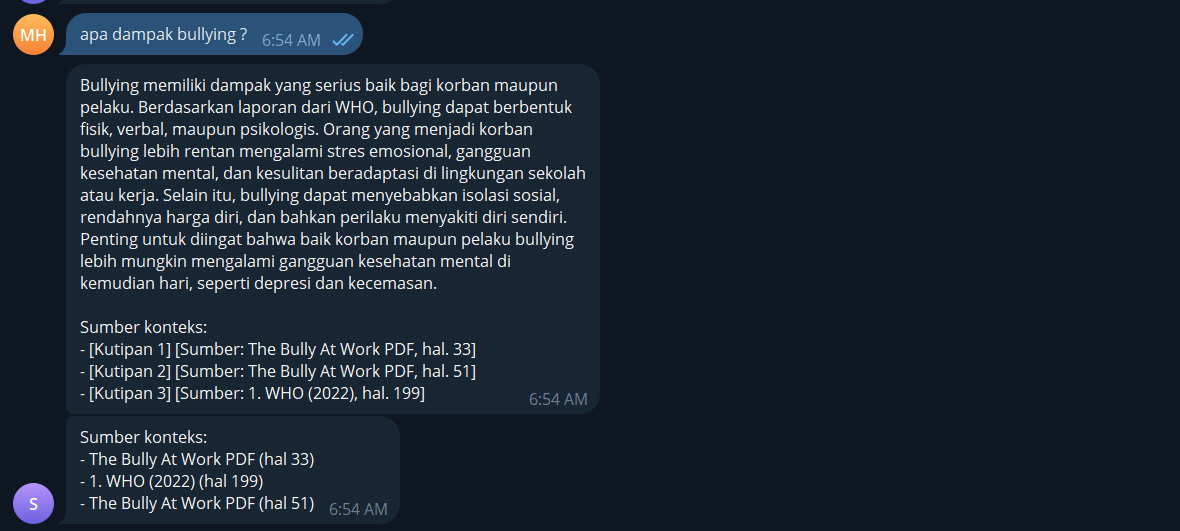
MINDHARBOR / HERO SCREENSHOT
IMPLEMENTATION DETAILS
The key decisions behind the implementation.
FastAPI services coordinate screening, routing, and response generation.
Qdrant embeddings and BM25 lexical search provide complementary context.
PostgreSQL holds deterministic screening state and structured rules.
Redis and Celery support the asynchronous retrieval workflow.
EVIDENCE & METRICS
06 / WHAT I LEARNED
The project made the tradeoff between deterministic structure and contextual retrieval visible. The next improvement would be continuing to test retrieval quality against the real screening requirements.